caura for the enterprise
Governed memory for AI agent fleets.Run where you need it, with the control you have to answer for.
One persistent memory every authorized agent learns from. Caura governs what agents read, write and delete in memory. Scope, policy and audit are enforced inside every memory operation. On-prem, air-gapped or white-label when the data cannot leave. SOC 2 Type II.
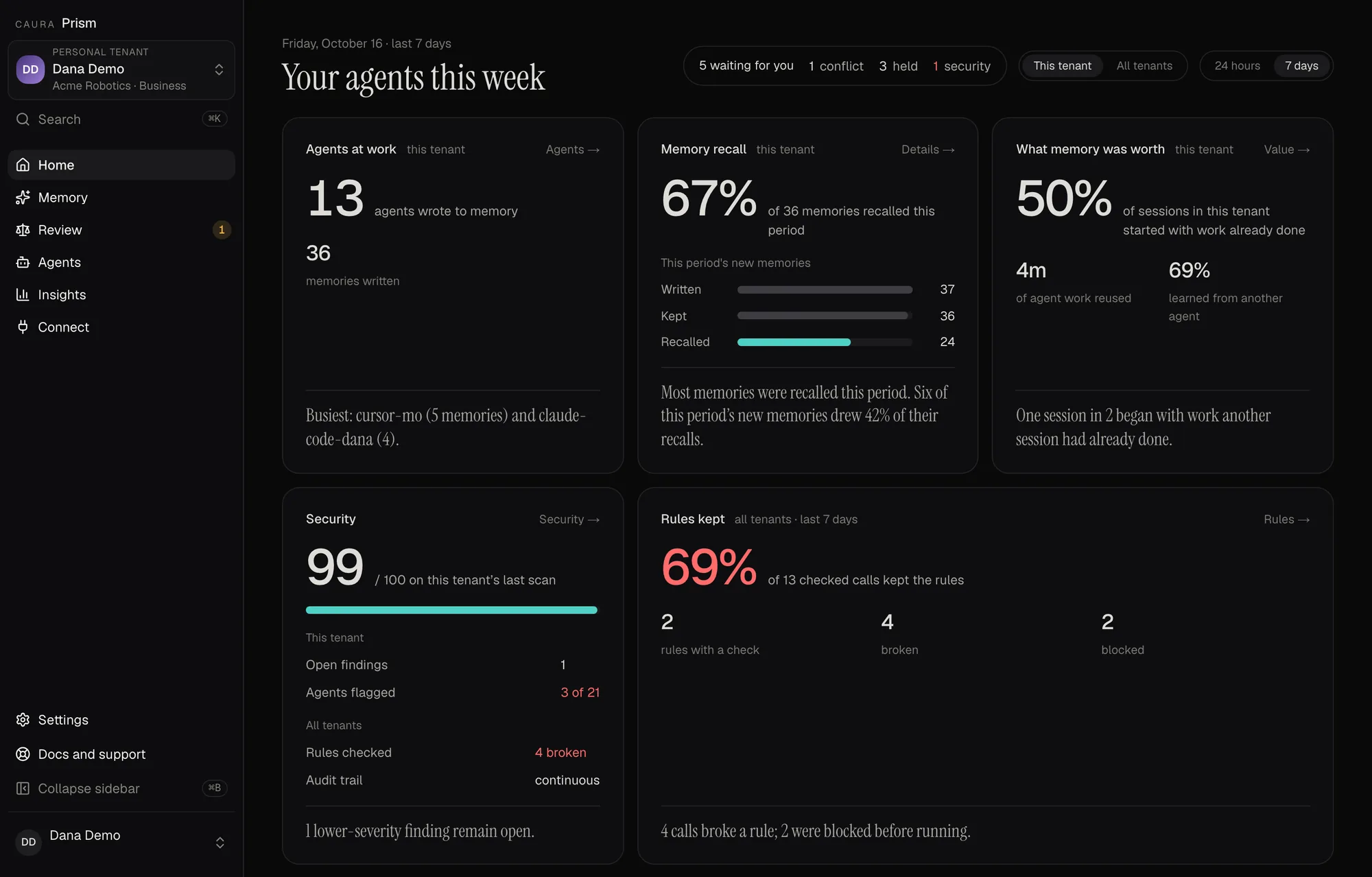
What the agents wrote, recalled and reused, per tenant.
Rules kept and security, across every tenant you manage.
Conflicts and held writes waiting on a person.
Caura Prism · Home. Shown on a demo tenant with synthetic data. The memory map, held writes and rules and receipts depend on features enabled for your organization.
Everybody is building agents. Most demos never reach production.
Agents forget between sessions and repeat each other’s discoveries. Nobody can say what the fleet knows, or whether it is still true. Governed fleet memory is the missing layer between demo and production.
in production
eToro runs Caura as a governed company brain for its AI-agent work.
One memory, shared across the fleet, inside one tenant.
Read the case study →The memory agents love.
Agents come and go. What they learn stays.
- PersistentLearned once, kept for every agent that follows.
- SharedEvery authorized agent in the tenant draws on one memory.
- CompoundingOutcomes tune recall; repeats crystallize into knowledge.
- Agent-nativeMCP, REST and Rail hooks. Usable on the first call.
The control enterprises need.
See everything. Decide who sees what.
- GovernedScope, policy and audit enforced inside every memory operation.
- IsolatedTenants isolate; fleets collaborate.
- AuditableEvery read, write and delete attributed and logged.
- VisibleWhat the fleet knows, who taught it, who used it.
Enterprise agents are making decisions on knowledge nobody can see.
Six stakeholder questions, each answered by a place in Caura Prism.
platform lead · memory
“What does our fleet actually know?”
Every memory with the agent and fleet that wrote it, searchable and mapped.
browseknowledge owner · review
“What needs my decision?”
Conflicts, near-duplicates and held writes, queued for a person.
resolvehead of ai · agents
“Are our agents keeping the rules?”
Which rules each agent's sessions loaded, and which agents are behind.
retuneauditor · memory · audit trail
“Who did what, and when?”
Every read, write and delete, attributed to an agent.
explainciso · insights · security
“Is anything leaking?”
Security scans of stored memory, with findings by severity and category.
re-scopefinance · insights · value
“What is the memory worth?”
Sessions that started from earlier work, and the agent time that reuse saved.
measureGovernance built in, not bolted on
Four boundaries. What the service enforces on every memory operation, and what it hands to agents.
- OrganizationOwnership, administration, compliance, billing. Managed through the dashboard.
- TenantThe hard isolation boundary. A key reads only its own tenant unless an org admin makes it a cross-tenant key.
- FleetThe default collaboration boundary. Cross-fleet access needs explicit policy.
- AgentIdentity, attribution, permissions and trust level. Any framework plugs in.
On every operation
On every write
Ongoing, after the write
Delivered to agents
Governance ships in the Apache 2.0 core. Enterprise adds on-prem, air-gapped or white-label deployment, dedicated support with an SLA, and a dedicated account manager.
Run it where the data lives
Same core and APIs, in the perimeter your reviewers require. Cloud and Enterprise add the Prism console.
Apache 2.0. The full engine and governance. Five minutes from git clone to working memory.
github.com/caura-ai/caura →Nothing to run. Same APIs, same governance, SOC 2. Free tier to start.
Get started free →On-prem, air-gapped or white-label. Custom limits, dedicated support with an SLA, and a dedicated account manager.
Plan a pilot →Unlimited agents and fleets on every plan. Pay for what you store and recall. Free tier to start. See pricing →
Security and procurement
What a security review asks for, and where to find it.
Report available on request under NDA. ISO 27001 is under evaluation.
- Tenant isolation enforced by server-side tenant resolution and application data-access scoping.
- Every read, write and delete attributed to an agent and logged; zero-hit recalls included.
- Content policy on every write: PII, PCI and secrets detected, then flagged, masked or dropped.
- Delete your organization from the console; copy needed records through the REST API and verify coverage before deleting.
- Security overview →Architecture, data protection, access control, monitoring, disclosure.
- Data Processing Agreement →Our DPA, for your privacy review.
- Service Level Agreement →Availability commitments and support response.
- Sub-processors →Who touches data on our behalf, and where.
Plan a fleet-memory pilot.
One workflow. Five to twenty agents. Two weeks. We measure three things: repeated failures avoided, knowledge reused across agents, and permission correctness.
- One workflow that matters, with five to twenty agents on any harness.
- A point of contact on your side for two weeks.
- The outcome you would use to judge it.
- A scoped tenant with governance configured for your fleet.
- Caura Prism over the workflow from day one.
- A written readout against the three measures below.
- 1Repeated failures avoided. Mistakes one agent made that others did not repeat.
- 2Knowledge reused across agents. Memories written by one agent and recalled by another.
- 3Permission correctness. Recalls that returned only what the caller was allowed to see.
Agents are replaceable. Their memory is not.
Questions from the buying side
Where does Caura run?+
Three ways, one engine. Open source under Apache 2.0, which you host yourself. Caura Cloud, the managed service, with a free tier and SOC 2 Type II. Enterprise, for on-prem, air-gapped or white-label deployment inside your own perimeter, with custom limits, a custom LLM pipeline, dedicated support with an SLA, and a dedicated account manager.
Is Caura SOC 2 compliant?+
Yes, SOC 2 Type II. The report is available on request under NDA. The security overview at caura.ai/legal/security describes the architecture, data protection, access control, monitoring and disclosure process.
How is memory isolated between tenants, fleets and agents?+
The tenant is the isolation boundary: the server resolves the authenticated tenant context and scopes data access to it in the application. The fleet is the default collaboration boundary, and cross-fleet access needs explicit policy. Every memory carries a visibility scope and every agent a trust level; recall returns only what the caller may see. None of this depends on the model following instructions: it is enforced by the service on every operation.
What does the enterprise get beyond the open-source core?+
Governance ships in the core: scopes, trust levels, keystones, content policy, contradiction detection and the audit trail. Enterprise adds the deployment options (on-prem, air-gapped, white-label), custom limits, a custom LLM pipeline, dedicated support with an SLA, and a dedicated account manager.
What does a pilot involve?+
One workflow, five to twenty agents, two weeks. You bring the workflow and a point of contact; we set up a scoped tenant with Caura Prism and deliver a readout against three measures: repeated failures avoided, knowledge reused across agents, and permission correctness.
Can we leave?+
Yes. You can delete your organization from the console. To keep data first, copy it through the REST API and verify pagination, private-memory visibility, and other record types. There is no complete organization-export button in the console; see the deletion guide before confirming. Agents connect over MCP and REST, so there is no proprietary client to unwind.
Tell us about the workflow.
The workflow you have in mind, roughly how many agents, and where they run. Someone from the Caura team replies by email, usually within one business day, with a proposed pilot shape.
info@caura.ai · caura.ai · github.com/caura-ai/caura